Scrap Baling Presses
In addition to press shears, pure scrap baling presses in various sizes and designs are also offered for the production of scrap packages. Starting with simple two-compressor presses for thin-walled production residues or cans, through to multiple-compressor presses with hinged lids for bulky mixed scrap.
Depending on the type of scrap, maximum edge length and the later use of the bales, the scrap baling presses are selected for the customer.
Due to the high level of reliability and compaction of Oberländer scrap baling presses, in addition to the classic operation as a “stand-alone” at the recycling yard, direct integration into production systems is also possible, so that the resulting scrap is compacted directly in line in order to reduce volume. Such baling presses are found in press shops in the automotive industry, the sheet metal processing industry, or the non-ferrous metal processing industry.
In addition to the pure baling press, loading units such as plate conveyors and tipping trough scales, as well as scrap package handling and stacking systems, can also be offered.
The automatic storage or stacking of bales on pallets, in railroad wagons or containers is a prerequisite for efficient recycling in industrial companies.
When it comes to complete baling systems, the focus is on automation so that operating costs and availability can be optimized. Oberländer Recycling Machines can offer all of this as a complete solution.
Ask us about your special solution.
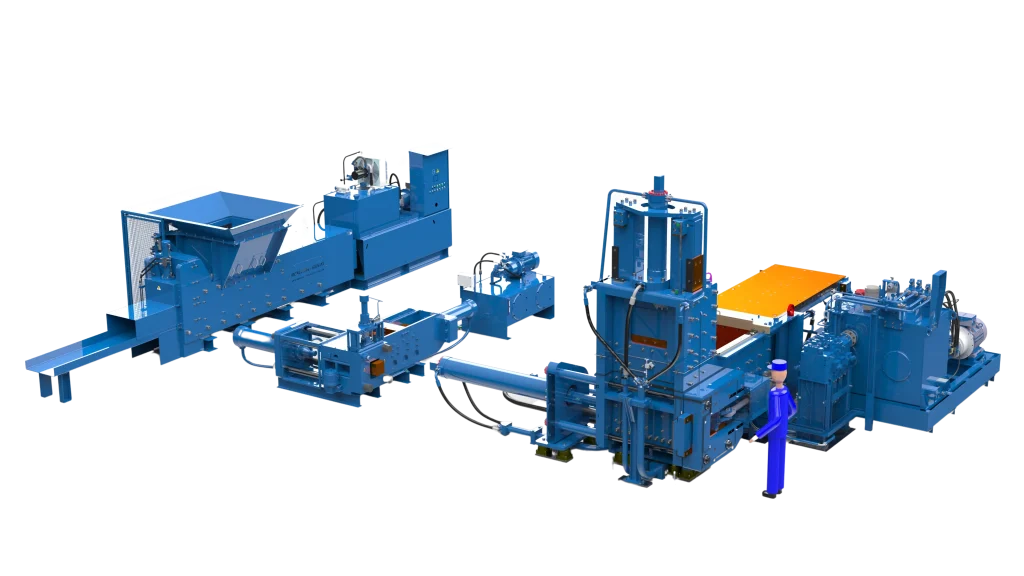
Based on many years of experience, different scrap baling presses are offered in terms of pressing force, size and baling performance based on knowledge of the raw materials, quantities and later use of the bales.
The Oberländer baling presses are characterized by high pressing forces, which compact the scrap into a rigid bale to avoid disaggregation even after intense handling operations. The use of compactors or hinged lids equipped with shear blades also ensures that protruding parts of large-volume scrap are cut off cleanly to produce clean bale edges.
| Type | Model | Press box dimensions | Bale size | Press force |
|---|---|---|---|---|
| P2 H 1000/500-2x2 | 2-Compactor Press | 1.0 x 0.5 x 0.3 m | 300 x 300 mm | 80 t |
| P3 HV 1900/1250-3x3 | 3-Compactor Press | 1.9 x 1.25 x 1.0 m | 300 x 300 mm | 180 t |
| P2 H 1900/1000-4x4 | 2-Compactor Press | 1.9 x 1.0 x 0.4 m | 400 x 400 mm | 260 t |
| P3 HV 2750/1450-4x4 | 3-Compactor Press | 2.75 x 1.45 x 1.0 m | 400 x 400 mm | 320 t |
| P3 HVK 5000/2000-5x5 | 3-Compactor + Lid | 5.0 x 2.0 x 1.0 m | 500 x 500 mm | 500 t |
| Smaller balers can also be offered in mobile versions. | ||||
| The presses are available in different hydraulic sizes to suit various bale capacities. | ||||
Frequently Asked Questions (FAQ)
What types of baling presses are there?
Scrap baling presses differ in the number and type of compactor stages.
Can and barrel presses only have a maximum of 2 compactor stages.
Lid presses such as car presses have side wings that enclose a press box and a final compactor ram that pushes the pre-pressed scrap together into a large bale. Lid covers can only generate a small pressing force and are normally used for cars, washing machines and other bulky scrap.
Two-compactor presses with pre- and final compactor rams are primarily used for non-ferrous metals (copper and aluminum alloys), since the press box height is determined by the bale height and, for larger pieces of scrap, protruding scrap must be sheared off from the press box. With ferrous scrap with long edges, this leads to higher maintenance costs on the shear blades. Two-compactor presses have a smaller press box volume and are cheaper than multi-compressor presses.
In 3-compactor lid presses, the 3rd compression is achieved vertically by a cover that folds down. They are mostly used for large-volume scrap or especially tough scrap such as stainless steel in scrap yards. They have the advantage that if the press box is overfilled (the bale can not be ejected through the baler door), the oversize bale can simply be removed using the gripper of the material handler.
- For 3-compractor stamp presses (e.g. P3 HV 2200/1500 3×3), the 3rd compression is achieved vertically by a compactor stamp, see animation on further up on our website. They are mostly used for large-volume scrap and high required baling performance and availability, e.g. in press shops where the production scrap is transported inline from the punching press on a plate conveyor.
According to what criteria are scrap presses designed?
Die Auslegung von Paketierpressen erfolgt nach:
- Schrottart (Stahl, legierter Stahl, Aluminium, Kupfer, etc.)
- maximaler Kantenlänge des Aufgabematerials
- Schüttdichte des Aufgabematerials
- notwendige Presskraft, bzw. Paketanforderung
- notwendige Paketgröße (200, 300, 400, 600 mm Kantenlänge)
- Paketleistung (t/Std.)
- Beschickungsart (kontinuierlich per Förderband, chargenweise per Umschlagbagger, etc.)
What is the difference between a chanel baler and a scrap press?
Channel baling presses, such as those used for pressing paper and cardboard, have a low specific pressing force in relation to the bale size (e.g. 1×1 m). These bales tied with wire or tape and transported with a forklift. They must not be too solid either, as they should be easily broken down again in the subsequent processing step.
Scrap baling presses work with higher pressing pressure and smaller bales. Bales from scrap presses must be dimensionally stable after pressing and must not fall apart after several material handlings. They are usually melted and therefore do not need to be re-opened.
Can I use a chanel baler to compress scrap?
Channel balers, such as those used for compressing paper and cardboard, cannot be used for compressing light scrap because:
- The specific pressing force per cm² of package area is too low and the package falls apart again despite being tied with tape or wire.
- The package size is too large to be reused in foundries and foundries and steelworks are reluctant to accept large bales, because they do not know what is “hidden” inside.
- Protruding material in the press channel is is torn off instead of sheared off during the pressing process, which leads to considerable wear when metals are used.
When do I use a scrap baling press or a briquetting press?
There are different versions of briquetting presses, the most common in metal recycling is the stamp briquetting press. It is used when the pressing forces for baling are no longer sufficient, with a briquette being smaller than a standard bale same pressing forces led to higher surface force.
If possible, it is always more economical to use a baling press, but if higher pressing forces are required, as with steel or cast iron chips, briquetting presses are used.
The feed material for briquetting presses usually has to be broken, sieved and freed from impurities beforehand so that it can be introduced into the round press channel of a briquetting press through the charging system. This would not be the case with baling presses, as they shear off protruding material and are less sensitive to foreign objects, such as turning tools in the chips.
Normal baling presses work with specific pressing forces of 1 – 3 kN/cm², briquetting presses for chips with forces of 5 – 8 kN/cm² on the cross-section of the bale or briquette.
Due to the lower specific pressing forces and the simpler design, the operating and wear costs of baling presses are lower. Whenever possible, a baling press should be used.